
What compounds?
Most people live in a non-compounding world. How can we escape existential decay?

We talk about compounding effect a lot in startups.
“Consistent effort compounds.”
“Long-term relationship compounds.”
But unfortunately, most things don’t compound. They just stagnate, if not decay.
We can do the same thing over and over again, but never grow.
So what actually compounds then?
Compounding is growth on growth.
When something compounds, exponential growth happens. Growth tomorrow becomes bigger than growth today.
To have tomorrow’s growth from today’s growth, today’s output has to become tomorrow’s input.
Great relationships that turn one meetup into even better time together in the future.
Great investments that turn its returns into greater future return.
Positive reputation that turn one review into better reputation in the future.
But the reverse is also true. Loss on loss.
Bad relationship, bad investments, and bad reputation can negatively compound.
So what makes compounding positive?
To compound positively, an action needs to have:
(i) Positive memory. It has to be cumulative: we have to remember what went well (and wipe out what didn’t).
(ii) Positive reinforcing feedback. It has to be regenerative: what went well should improve all subsequent future actions.
(iii) Many iterations. It has to be iterative1: we have to go through many cycles to reap the benefits.
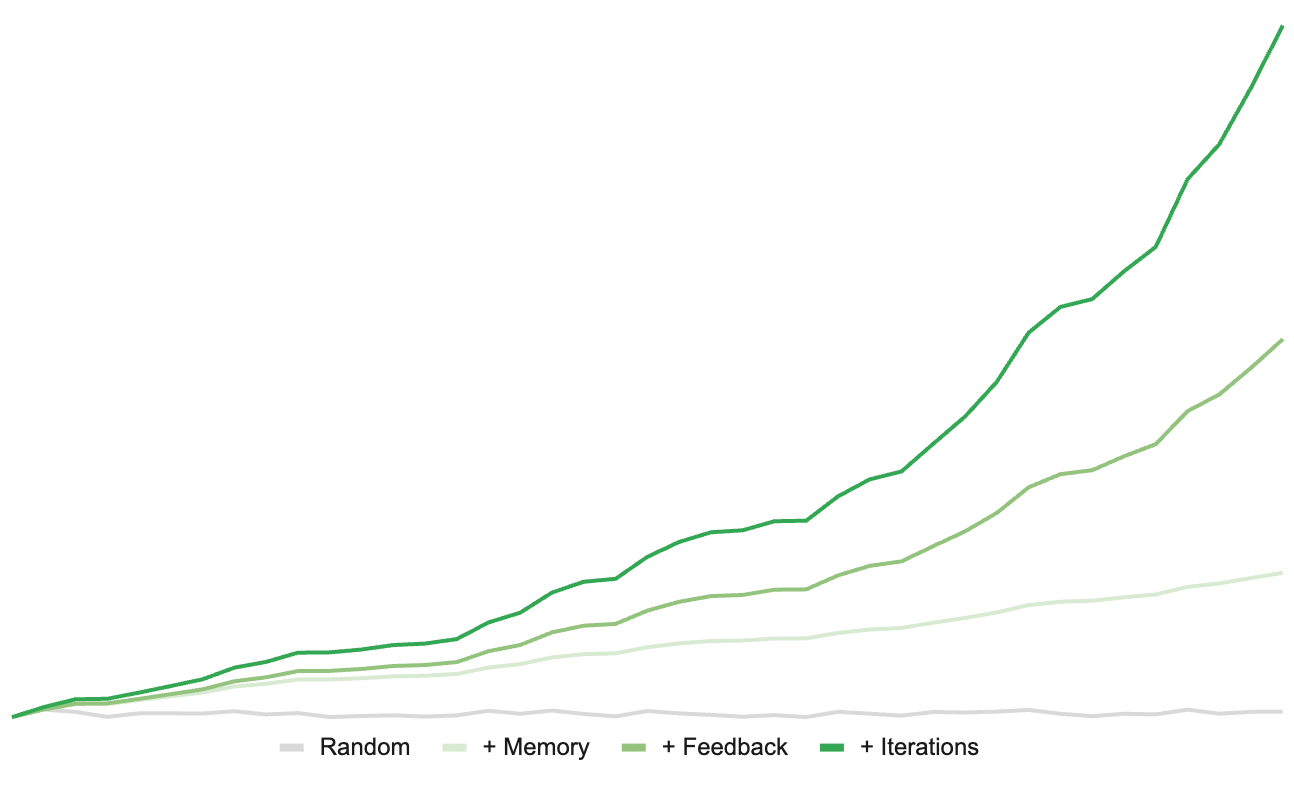
Unfortunately, most people have never experienced compounding effect in their lives.
And since they haven’t seen it, they just cannot comprehend it.
Our society has trained us so hard to think linearly, that non-linearity feels like a myth to us.
But once we’ve experienced it, it becomes so hard to not compound.
Because the difference between compounding and stagnating gets larger and larger over time.
And post-AI, not compounding is an extremely high opportunity cost, if not existential cost.
So let us find great people to foster compounding long-term relationship with, and commit.
Let us find great companies to build compounding investments with, and commit.
Let us find great cumulative, regenerative, and iterative systems to build compounding actions with and commit.
With Love,
Koshu
Mathematically, compounding can be shown as:
Where A is the future value, P is the initial value, r is the growth rate and t is the number of growth cycles, compounding effect is A - P.
This means that:
The higher growth rate we have, the higher the compounding effect.
The more growth cycles we go through, the higher the compounding effect.
Now these are standard definitions, but don’t answer the question of what actually compounds.
Now, let’s compare this against the linear growth equation.
Where A* is the future value, P is the initial value, r is the growth rate and t is the number of growth cycles, compounding effect is A* - P.
So how are these two different?
The difference can be shortened as follows:
= (A - P) - (A* - P)
= A - A*
= P x (1+r)^t - P x (1 + rt)
= P x ((1+r)^t-(1+rt))
= P x (tr^(t-1)+(t-1)r^(t-2)+….)
= f(r^t)
In short, the difference between linear growth and compounding growth is the T, the number of growth cycles. In other words, if we can maximize the number of iterations, the compounding effect will be maximized (provided that there’s positive memory and reinforcing feedback r).