

Over the past few months, I’ve been distilling my journal notes into (1) life principles and (2) personal compass.
It feels liberating to clear out mental clutters. And simmer them down to just a few connected mental models.
I will gradually cover all of them here, but I’d like to start with my #1 life principle: “Survive, then thrive”.
We too often attempt to thrive before properly surviving in the first place.
Trying to help others before dealing with our own problems.
Trying out new productivity tools before even getting basic tasks done.
Looking for the best gift for family and friends before frequent quality time together.
If we die, we obviously cannot thrive. So before optimization, we should be asking ourselves survival question first.
Invert, always invert.
Charlie Munger of Berkshire Hathaway has preached this over and over.
A lot of success in life and business comes from knowing what you want to avoid: early death, a bad marriage, etc.
I’m finally coming to realizing how true this statement is.
If we’re alive, we have a non-zero chance of achieving what we’d like to achieve. If we’re dead, it’s a zero chance.
And the difference is infinite.
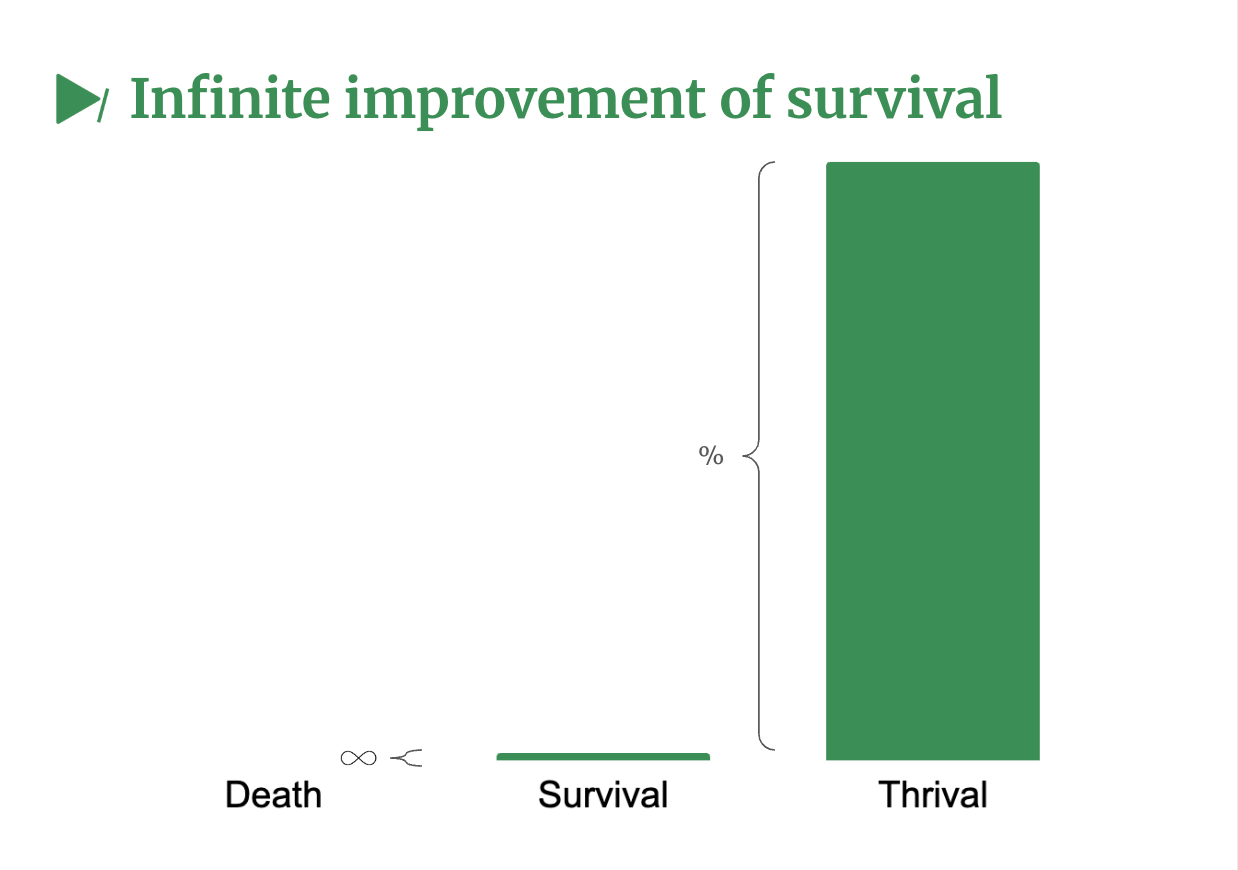
So however pessimistic it may sound, for any success we should always think of failure first.
“How can we die…early?”
Anything that exists can cease to exist. From status to money to relationship to life.
Nay. Anything that exists today will cease to exist one day.
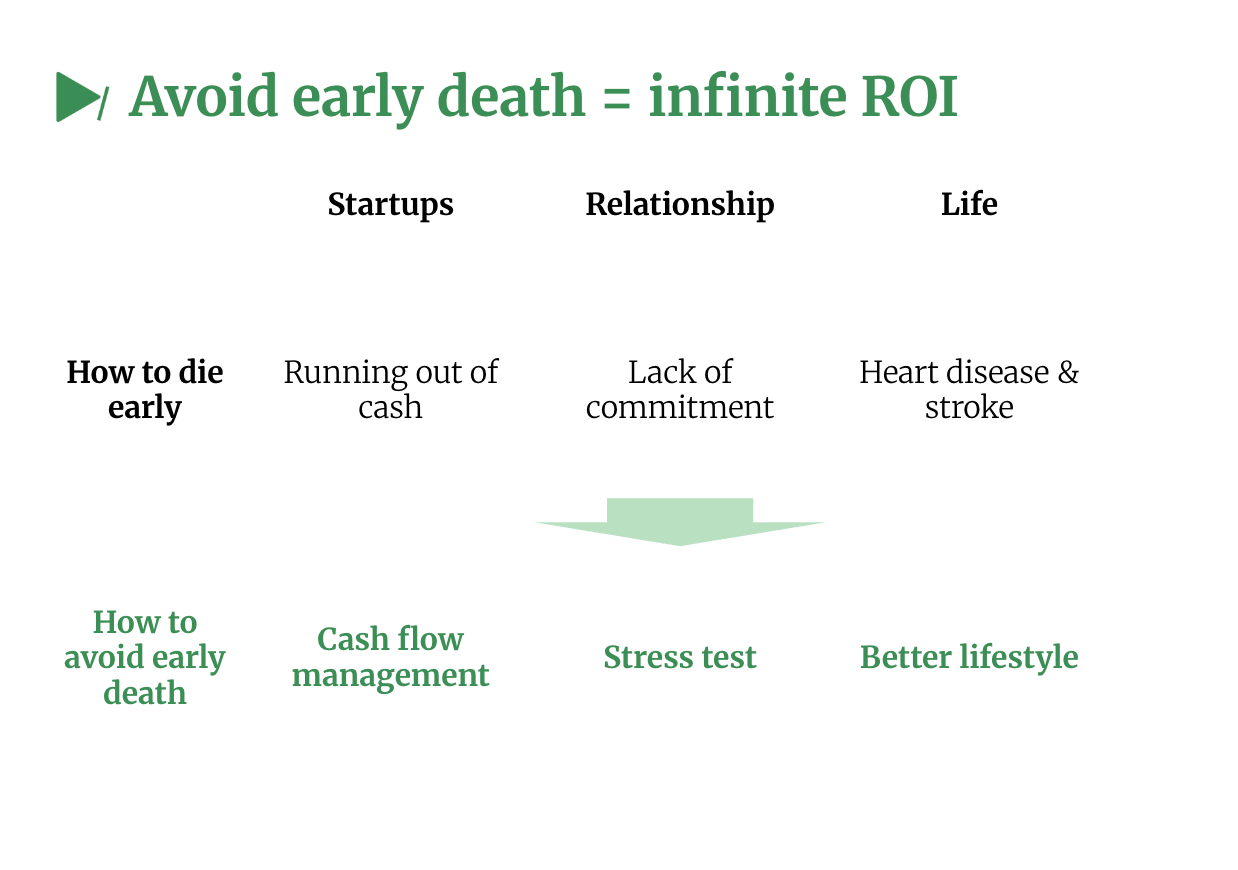
So the inverted question should then be “How can we die early?”
And all we have to do is to avoid early death.
Startups can die early by running out of cash. So manage spending.
Relationships die early by lack of commitment. So stress test.
Cardiovascular diseases kill us the most. So improve lifestyle.
Of course we can never eliminate 100% of any risk.
But it only takes avoiding the major cause of death to significantly reduce early death risk. And since the reward is infinitely better (vs death), the ROI is infinite.
Thriving externally, dead internally
Survival is not about consuming self-care products.
Most self-care products will not help us avoid early death. They just help us delay actually taking care of ourselves.
Ironically, such siloed optimization is precisely what is making us metaphysically die earlier.
Our body is alive, but our mind is dead.
And with AI, it’s becoming more and more the case.
Less friction. More personalized. Less thinking. More echos.
We may look like we’re thriving more, with more to-do list items ticked, with more dating chats, with more self-care products.
But until we reown ourselves, to intentionally avoid early death, we may be collectively decaying on the inside.

Survive, then thrive
Life is extremely nonlinear, and a few events can make or break our lives. Invert to find major negatives (”how to die early”), remove major negatives and then maximize major positives.
Focus our energy on what can go right vs everything that is going bad. Survive, but then thrive. Think once on how it can go wrong, and do everything to prevent it. But then, focus on what can go right, and work on it.
Survive, then thrive.
Defend, then attack.
Live, then love.
With Love,
Koshu
Focusing on surviving first before optimizing everything else is a simple but important reminder that avoiding major risks comes before trying to maximise outcomes