
Not sleeping on sleep
Is it time to finally sleep seriously?

Throughout my life, I have always been a good sleeper. I inherited this from my Mom. One of my very few natural talent.
But over the past few months, I have become far more serious about sleep.
Perhaps it is more exercise, perhaps it is my age.
But my latest belief on sleep is:
Anyone who wants to grow should take sleep seriously.
Sleeping on sleep
We often treat sleep, or any inactivity, as “unproductive.” Thinking that if we are not moving, we are not doing anything useful in life.
As a result, we sleep less than a few decades ago, and significantly more people sleep less than 6hours1.
This has become extreme that short sleep is often shared as a badge of honor. “I worked too hard that I only slept 6 hours last night.” Some startup founders I work with also fall under this trap, mostly driven by input-focused 996 culture.
There are high cultural variances, of course. Japan and South Korea, for instance, boast the least amount of sleep among the OECD countries. In day-to-day conversations, it’s normal to hear from my Japanese friends saying “I slept long today,” when they sleep more than mere 6 hours.
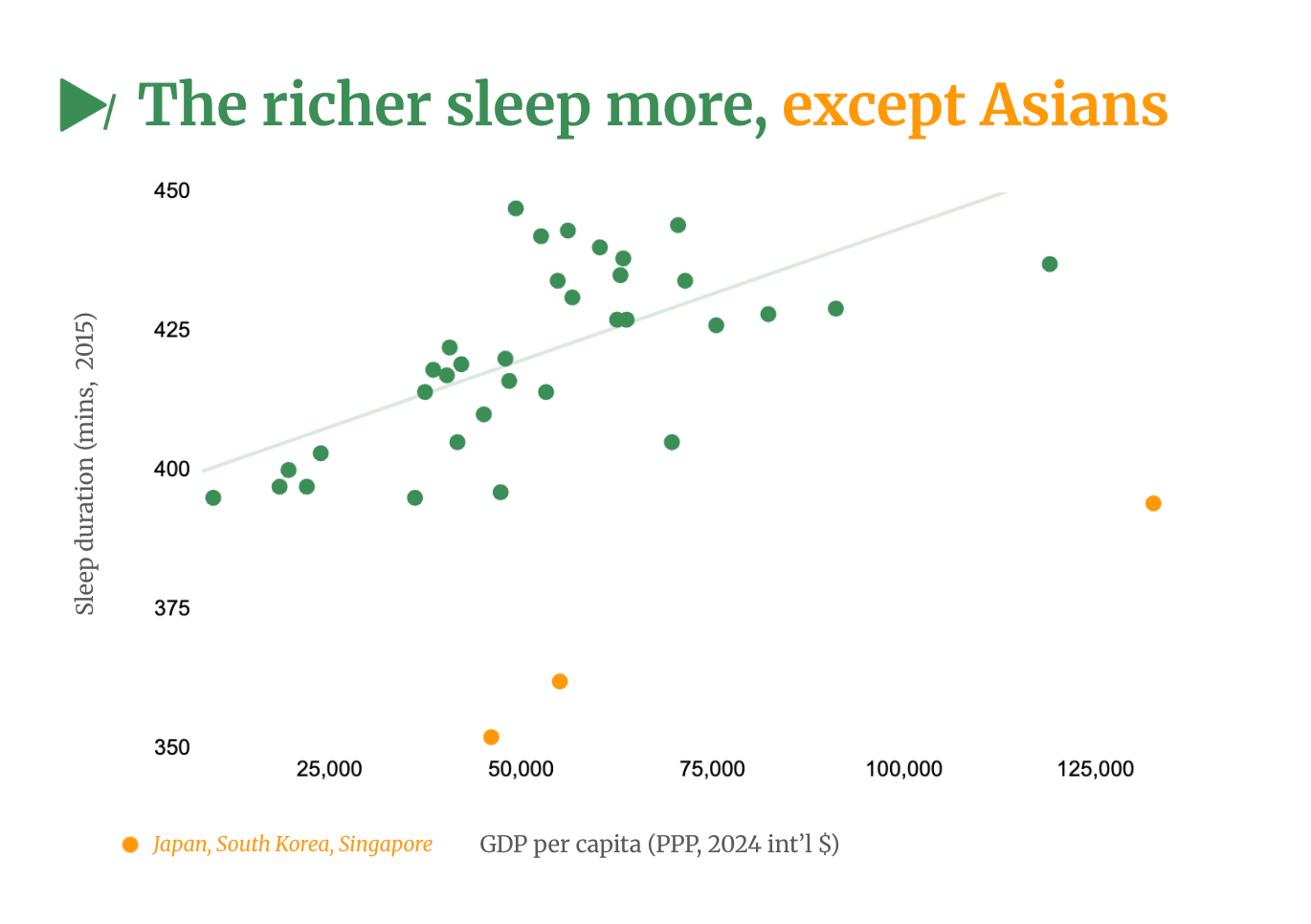
But ironically, there’s a strong correlation between income and sleep duration, much stronger after removing these culture-led outliers (Japan, Korea and Singapore). And anecdotally, I find similar dynamic exists among the startup founders, where those who sleep the least underperform in the long-run. This shouldn’t be a surprise though. If <5hrs sleep is cognitively equivalent to drunk driving2, why would it be different for work?
Why do we not sleep well today?
Light at night is by far the biggest key driver of worse sleep quality and quantity.
Light from the ceiling, light from our phones and laptops, light from the street and buildings outside, light everywhere. Today, we live with light as if we are allergic to darkness.
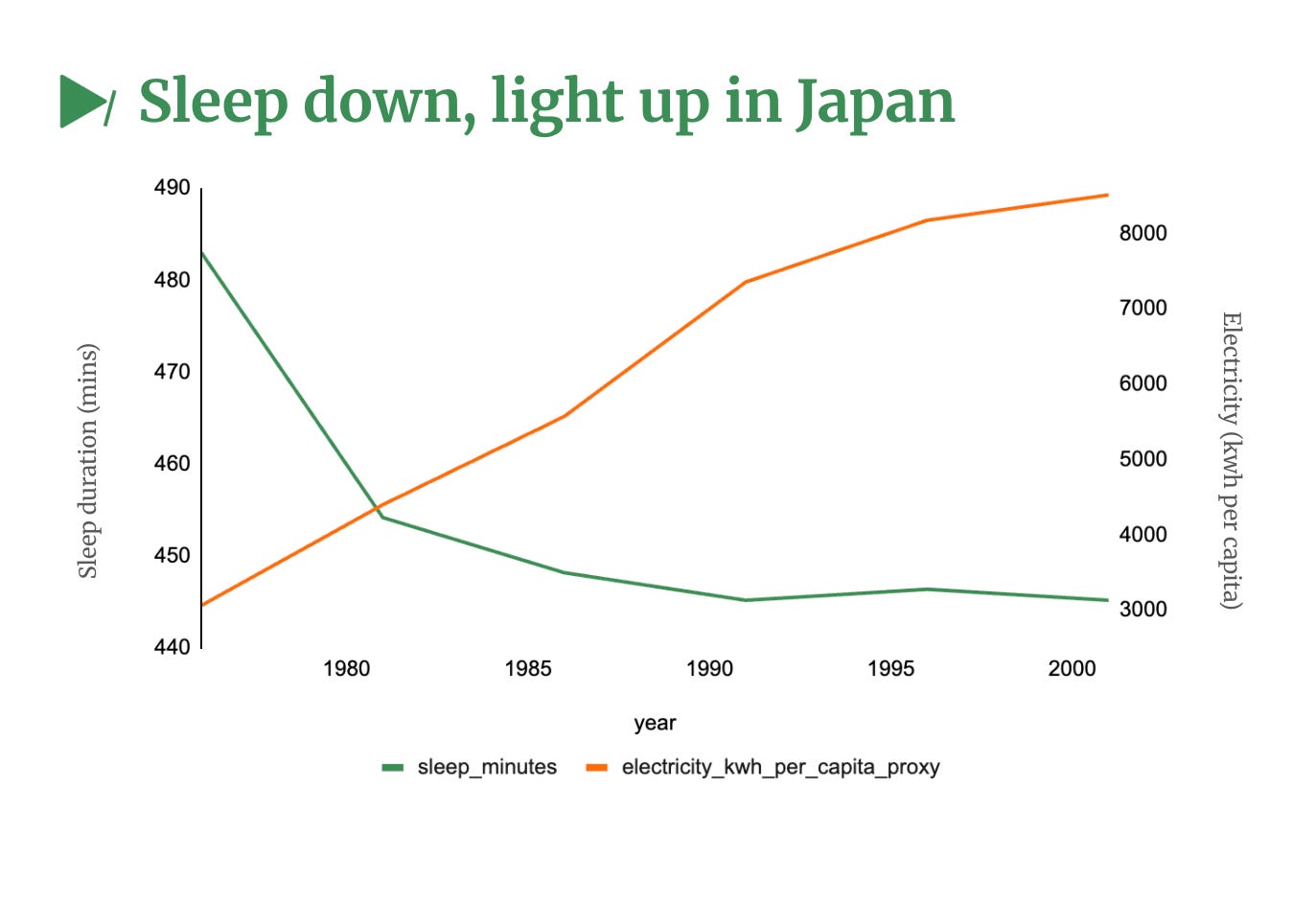
We can blame bad sleep on capitalism, social media or work stress how much ever we want. But without light (and internet connectivity), we can’t be awake for long. If in doubt, try staying up all night in the pitch black with no light and internet.
Why should we sleep then?
As I am not a sleep scientist, I won’t go into the what, how, why of sleep (I’d recommend Matthew Walker’s Why We Sleep).
But one key finding from neuroscience that has changed my perspective on sleep is:
Our muscles grow, our memory consolidates and synaptic connections are strengthened during sleep.
Controlled studies show that deep sleep triggers peak growth hormone release for muscle repair, memory performance improves significantly after sleep compared to wakefulness.3
So sleep is not just important. Sleep is a must in growth. Without sleep, we won’t become more adaptive.
Sleep is how we convert effort into increased capacity.
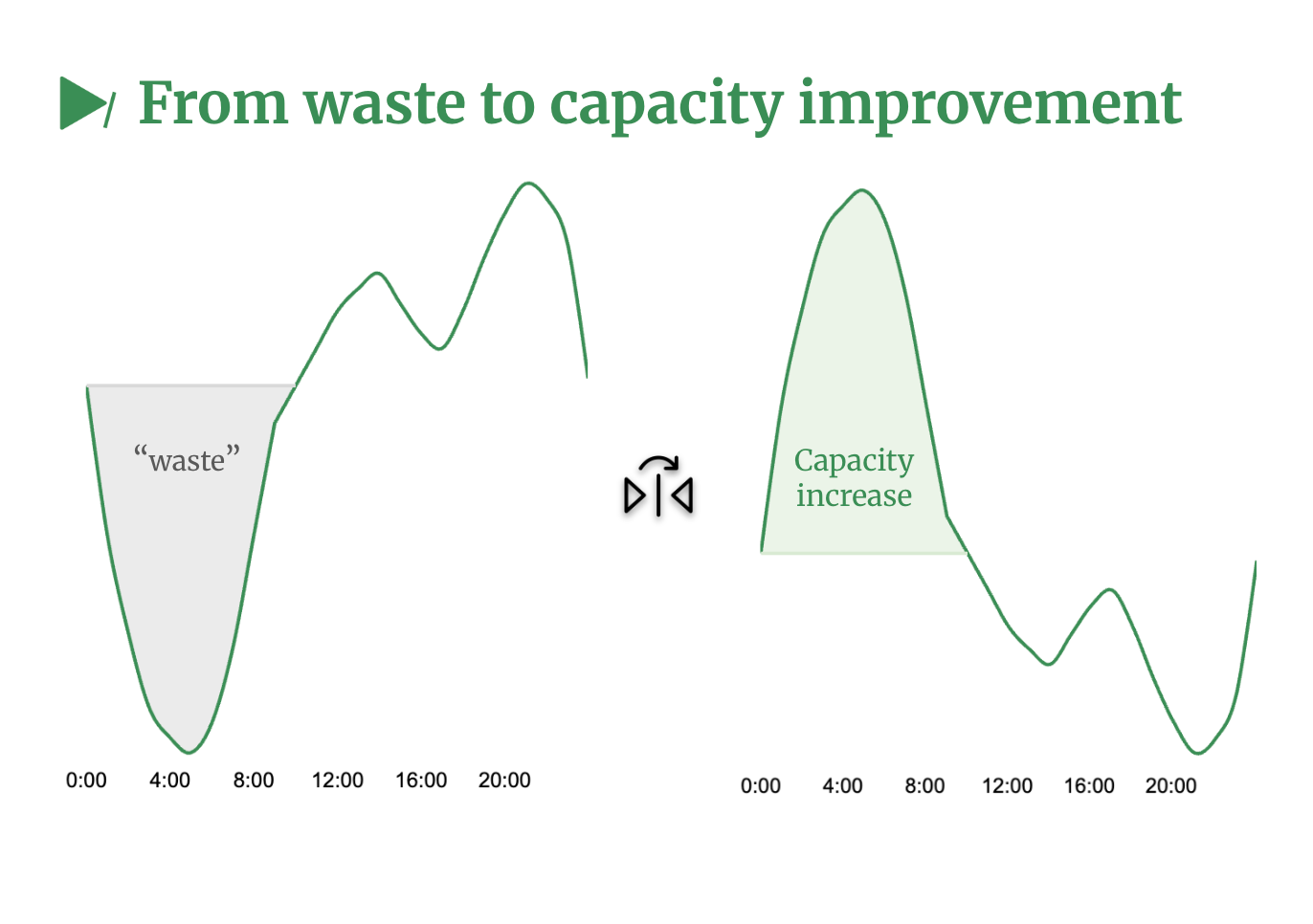
When we flip our mindset this way, it makes it far easier to see why we should sleep. At least for those of us who would like to grow.
How should we sleep better?
If light drives sleep behavior change, then we should change light. Structurally.
Default light reduction at night. (e.g. X mins before sleep, to turn down/off light at home, laptop, phones, or anything else).
I have myself tested several best practices, from different beds and pillows, to cooler temperature (18c), to meditative music to mouth taping to taking L-Theanine.
But so far, the most effective one for me is automatic dimming of light (using a smart home app) and automatic blocking of all apps except an alarm clock on my phone (e.g. Opal) 30mins before sleep.
As with anything important in life, we should test it ourselves. To see what works best for ourselves. Oftentimes, what works well for others may not be the best solution for us, and vice-versa. And what works well for us today may not be the best solution tomorrow.
But for me, changing my default light exposure has tremendously helped with going to sleep, the quality of sleep itself, and even waking up.
And I genuinely hope that we can collectively wake up to sleep better (puns obviously intended).
With Love,
Koshu
Earl S. Ford, Timothy J. Cunningham, Janet B. Croft, Trends in Self-Reported Sleep Duration among US Adults from 1985 to 2012, Sleep, Volume 38, Issue 5, 1 May 2015, Pages 829–832, https://doi.org/10.5665/sleep.4684
Sprajcer M, Dawson D, Kosmadopoulos A, Sach EJ, Crowther ME, Sargent C, Roach GD. How Tired is Too Tired to Drive? A Systematic Review Assessing the Use of Prior Sleep Duration to Detect Driving Impairment. Nat Sci Sleep. 2023;15:175-206
https://doi.org/10.2147/NSS.S392441
Lutz, N. D., Harkotte, M., & Born, J. (2026). Sleep’s contribution to memory formation. Physiological Reviews, 106(1). https://doi.org/10.1152/physrev.00054.2024
Figueiro, M. G., & Pedler, D. (2023). Cardiovascular disease and lifestyle choices: Spotlight on circadian rhythms and sleep. Progress in Cardiovascular Diseases, 77, 70–77. https://doi.org/10.1016/j.pcad.2023.02.004