
Artificial intelligence, artificial wants
What is intelligence? Really.

With AI, we talk a lot about “intelligence” these days.
Has AI reached human-level intelligence?
Are we getting less intelligent with AI?
But, we can’t compare what we can’t measure, and we can’t measure what we can’t define.
So let us define it first.
What is intelligence?
Many of us wrongly define intelligence.
Intelligence is not how much we know, measured by amount of knowledge (“recycled knowledge”)
Intelligence is also not how much we can think, measured by IQ
Intelligence is also definitely not how much we can write, measured by the # of line of codes or letters
So what is intelligence then?
I have two favorite definitions:
Biological intelligence = The ability of navigate problem spaces to achieve goal - Mike Levin
“The only true test of intelligence is if you get what you want out of life.” - Naval Ravikant
I like them both for reasons I’ll touch upon below.
But adjusting for “human” intelligence, I’ll merge the two into:
Intelligence is navigating problem spaces to get what we truly want.
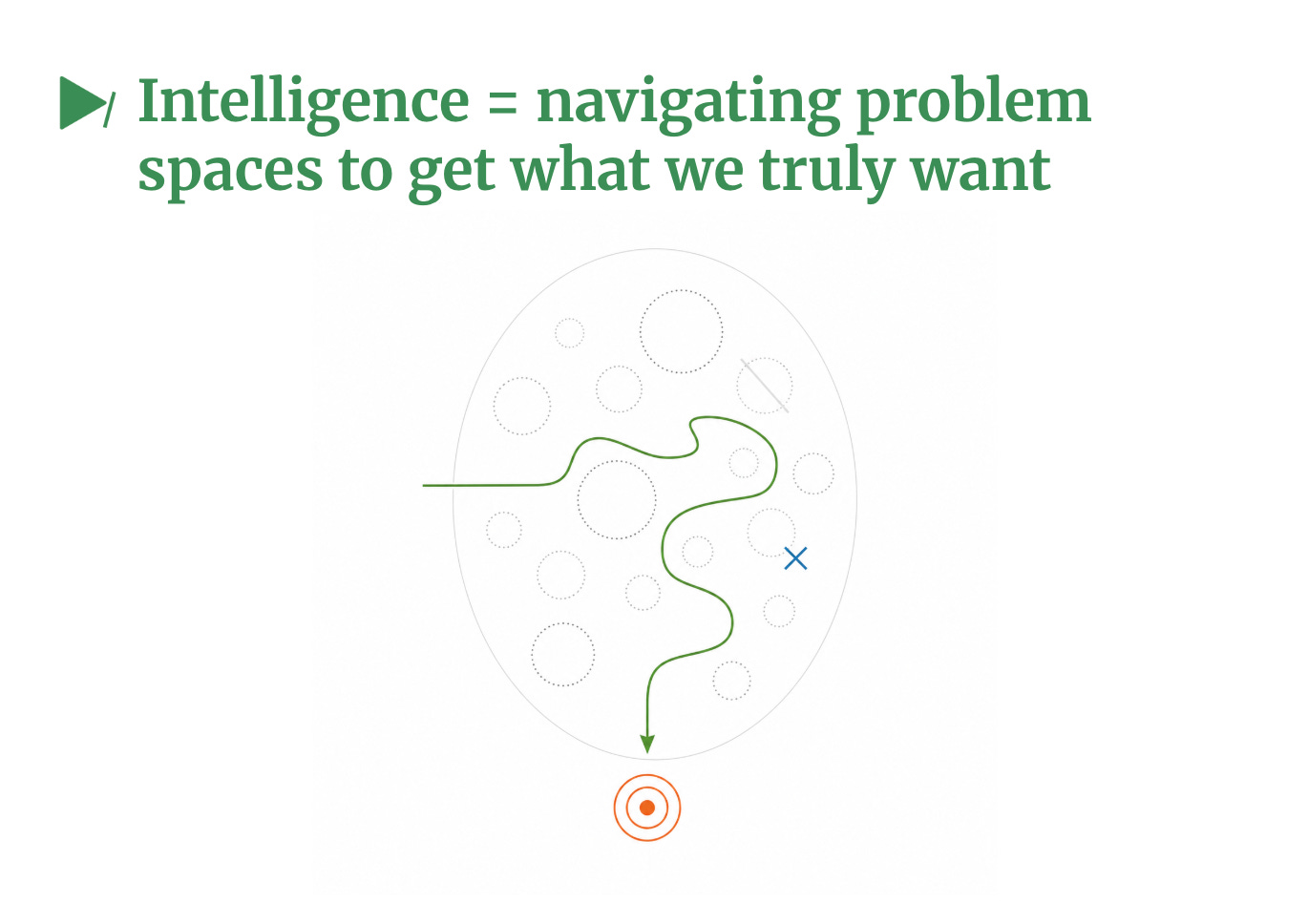
Navigating problem spaces
In startup, this is what we often call “resourcefulness.”
Can the founders “figure it out?”
With everything else equal, the more we know the better we can navigate.
But so often, we may know a lot, but we can’t even solve some of the simplest problems in our lives (also known as “first world problems”).
Or the other way around: even without knowing a lot, we can sometimes resolve or work way around problems.
What I particularly like about the phrase “navigating” is that it’s proactive and adaptive.
This is particularly relevant in the AI age.
With more uncertainty (certainty of uncertainty), we should be proactively preparing for future obstacles, and adapting to avoid, reduce or overcome obstacles.
To get what we truly want
Authentic goal setting is crucial.
If we don’t know what we want, we may be solving the wrong problems.
Or if we want the wrong things (like love proxies), we may even make up problems for ourselves (problems with problems).
Even worse, we realize, after getting what we wanted, that this was never what we truly wanted.
Today, with more distractions and noise than ever, knowing what we want, not what others want or what others (or AI) say we should want, is half of what intelligence is about.
How can we be more intelligent?
Intelligence is navigating problem spaces to get what we want.
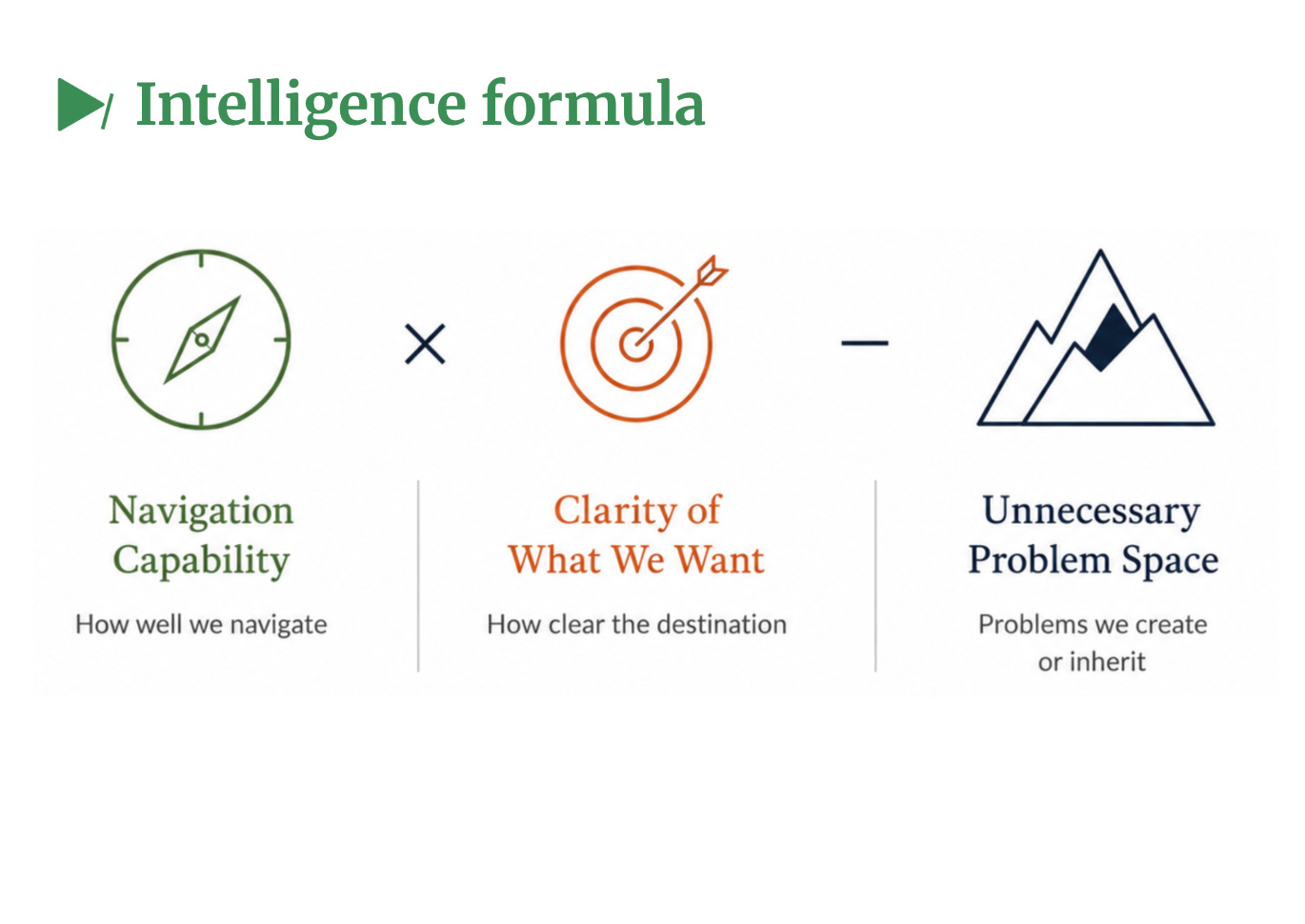
Hence, it’s a function of our navigation ability and the overall size of problem spaces for what we ultimately want.
We can then reduce intelligence to the following formula:
Intelligence = navigation x problem spaces | our want
Following this, there are three ways to get more intelligent.
Improve navigation: Most problems are navigatable. In general, with experience, this gets easier. But we can also navigate better by leveraging resources. If we can’t build a full product with limited budget, use AI tools and customer conversations to build a functional prototype. If we want more X, use anything at our disposal to make it. Let us use tools or other people to help us navigate better, even our constraints.
Minimize problems: Many times we don’t need to have these problems to begin with. Make better structural decisions, and many problems won’t come up. Build a startup in a talent-dense city, we can avoid talent shortage problem. Be with a compatible life partner, we can avoid daily arguments. Let us stop manufacturing problems.
Clarify what we truly want: Minimize our wants, especially artificial ones, and focus on what we truly, deeply, madly want. And if we don’t know it, then make finding what we truly want our goal.
Seeing this, it’s clear why many AI companies are moving from pure LLMs toward AI agents (and eventually toward decision AI).
We need more problem navigation, not volume knowledge.
But at the end of the day, it is up to us, each one of us, to know what we truly want.
How can we expect AI agents to be intelligent when we don’t even know ourselves?
Let us ask ourselves:
What is it that what we truly, deeply, madly want?
And let us navigate problem spaces to get there.
With Love,
Koshu
As usual, you're writing about exactly what's been on my mind lately. Thanks again.
I get the urge to separate the equation into sub factors, but I can't see how Improve navigation and Minimize problems don't collapse in a single factor: basically just navigation. What might I be missing?