
Minimizing the minimum
Law of the minimum everywhere

I used to think output was about simply adding more inputs.
Today I think output is about minimizing the minimum.
Output = f(Minimum of A, B, …, Z)
We are as good as our most limited essential input.
Liebig’s law of the minimum
Justus von Liebig, a German scientist in the 19th century made an observation that plant growth is controlled not by the total resources available but by the scarcest essential nutrient.
If a plant needs nitrogen, phosphorus, potassium, sunlight, and water, its growth is determined by whichever of those is least available, relative to what the plant needs.
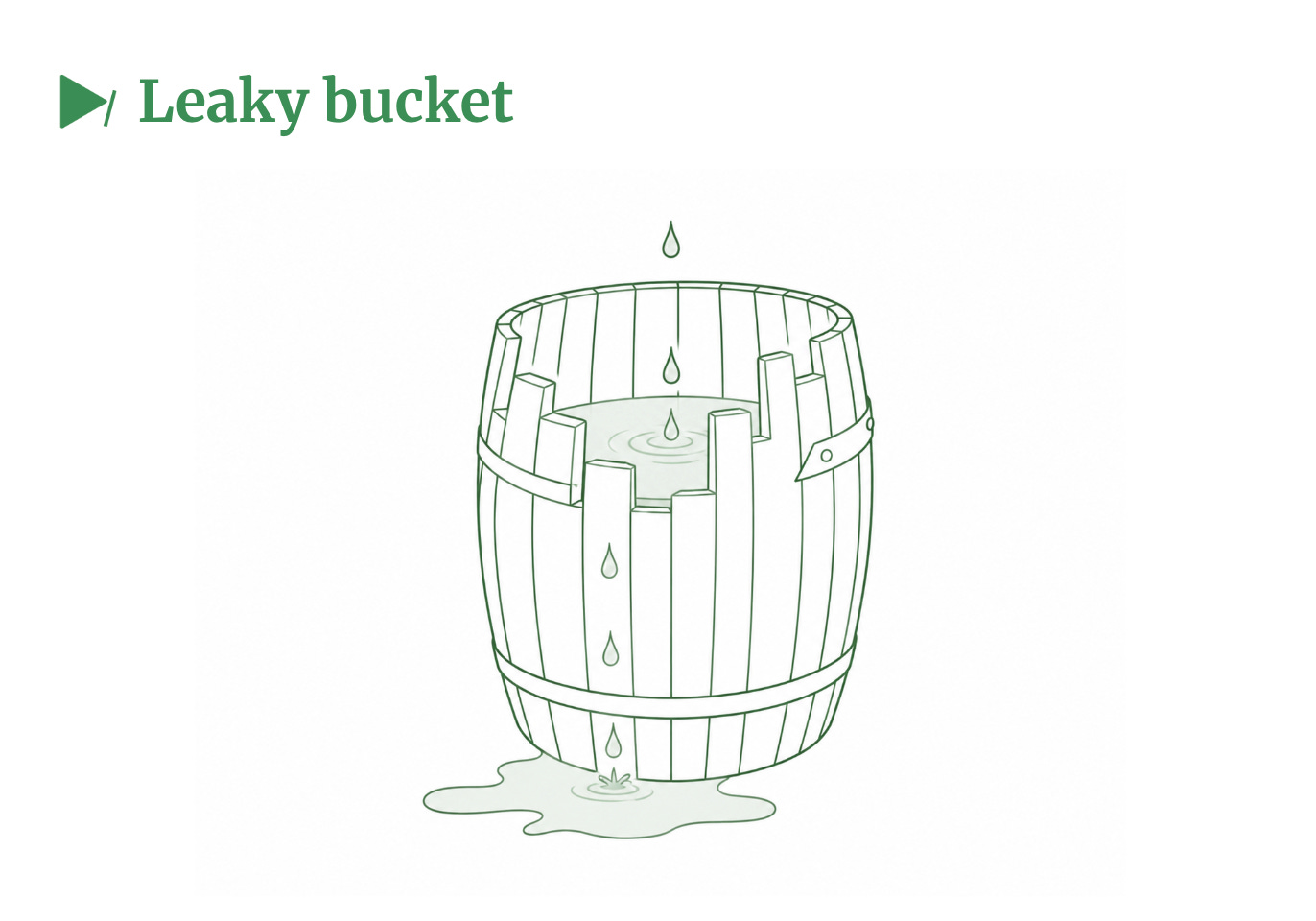
The classic visualization is the “Liebig barrel.” Each wooden plank represents a nutrient. The barrel can only hold water up to the height of the shortest plank. Increasing taller planks does nothing until the shortest plank increases.
Migration of the minimum
From startups to life, many important systems follow the law of the minimum.
It’s not a function of addition or even multiplication, because these components are not separate but rather interacting with each other.
So we improve the absolute minimum, the output improves. We improve non-minimum up, the output doesn’t change.
Startup → weakest of team, product and market.
Health → poorest habit.
And what’s interesting is that, once we solve for the minimum, the bottleneck moves to another aspect.
Once engineering team improves, marketing team suddenly becomes the bottleneck.
Once sleep improves, exercise suddenly becomes the bottleneck.
So a bottleneck is a given, and success isn’t reaching a state without bottlenecks. Rather, progress is about continual migration of bottlenecks.
Scarcity increases value (Scarcity of scarcity). Hence, every technology that solves for the major bottleneck is highly valued. As such, capital and talent flow toward creating such new technology.
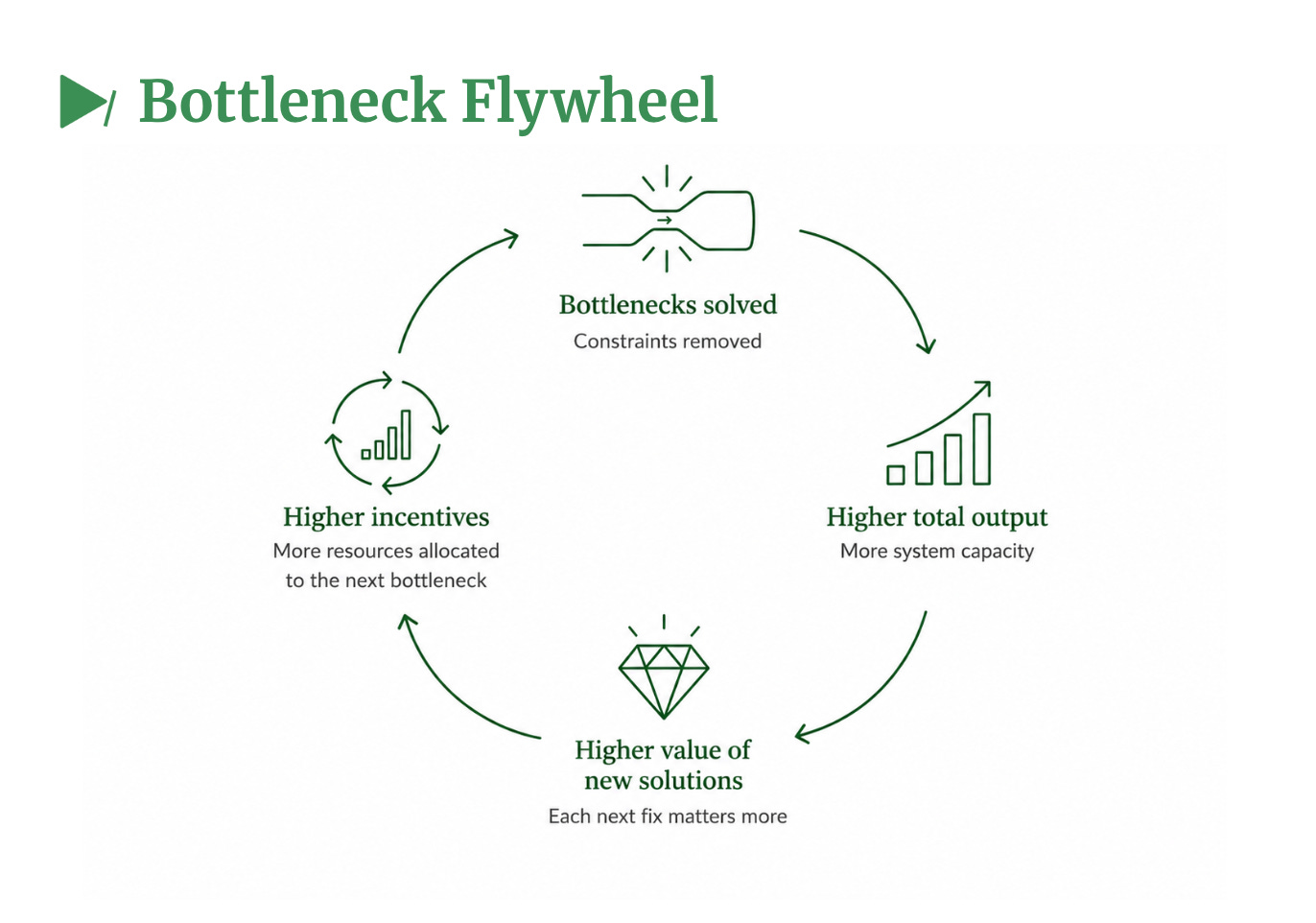
And the bottleneck flywheel is born: the more we solve for bottlenecks, the higher total output may be, the higher value a new solution for bottlenecks becomes, and thus the higher incentive people have for solving for bottlenecks.
Removing minimums
Major minimums in life bring down our entire life.
Without good health, sleep, food, sufficient income, and social interactions, our life is significantly limited.
So, much of our lives should be focused on removing any current major bottleneck. Simply removing them can make our lives significantly better.
Life success is not maximizing everything.
It’s about minimizing the minimum, continuously.
Let us ask ourselves:
What is the biggest bottleneck in my life now, and how can I solve for it?
With Love,
Koshu
This is a highly useful approach to understanding both startup solutions and life. Analogous to understanding that happiness is sometimes about removing things that cause you pain.